Rooting Hormone: Do You Really Need It? Alternatives for Windowsill Propagators
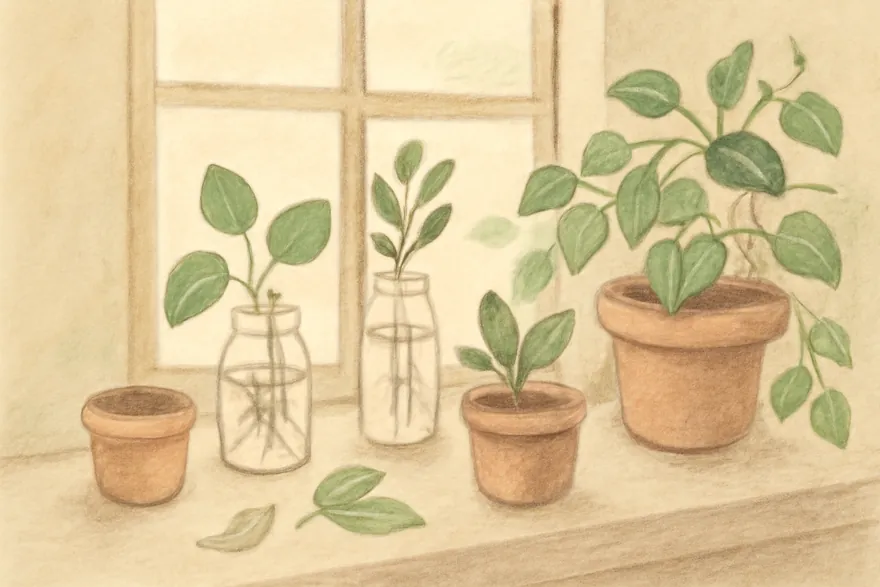
Rooting hormone gets treated like a miracle powder, but it doesn't create roots out of nothing — it speeds up a process the cutting was already capable of, and only for species that respond to auxin in the first place. Understanding what's actually in the jar changes how you decide whether to buy it, skip it, or mix up something from your kitchen instead.
What Rooting Hormone Actually Does
Commercial rooting products contain synthetic auxins — usually IBA (indole-3-butyric acid), sometimes NAA (naphthaleneacetic acid), or a blend of both. Powders typically run 0.1%–0.3% concentration for soft, herbaceous cuttings and up to 0.8%–1% "hard-to-root" formulas for woody stems. What the auxin does is trigger cell division at the wound site faster and more uniformly, so you get a thicker mat of roots in less time, with fewer cuttings rotting before they root at all.
It does not make an incompatible cutting root. A hormone-dipped rose cutting can still fail from bacterial rot, low humidity, or a stem that was too old and lignified to begin with. Hormone shortens the timeline and improves the odds for species that are already rootable — it doesn't override bad technique or a genuinely difficult plant.
Which Cuttings Actually Need It
Plenty of the plants windowsill propagators grow root just fine in a plain jar of water, no additive of any kind:
- Reliable in plain water: pothos, philodendron, tradescantia, coleus, begonia, mint, basil, ivy — these typically show root nubs in 7–14 days with zero hormone.
- Benefits from a stimulant but not strictly required: hydrangea, fig, citrus, gardenia — rooting is possible without help but can take 2–4 weeks longer and the failure rate climbs.
- Genuinely harder cases: roses (especially from firm, semi-hardwood stems), azalea, camellia, juniper and other conifers — these respond noticeably to a real auxin source, and skipping it often means a much lower success rate rather than just a slower one.
If you're rooting the first group, save your money and your hormone jar — the extra step adds nothing measurable.
Three DIY Stimulants Worth Trying
Willow Water
Young willow (Salix) stems contain both salicin, which breaks down into salicylic acid and helps suppress the fungi and bacteria that cause cutting rot, and a small natural auxin content. It's the closest thing to a genuine DIY hormone substitute, though it's far more dilute than a synthetic 0.3% powder.
- Cut pencil-thick, first-year willow growth (green or slightly yellow-green bark, not gray and woody) into 1-inch pieces.
- Steep a handful in a jar of room-temperature water for 24–48 hours, or simmer for 20 minutes and let it cool completely.
- Use the strained liquid as the soaking water for new cuttings during their first week, or as a pre-plant dip for 2–4 hours.
- Refrigerate leftover willow water and use within 1–2 weeks; it loses potency and can grow its own microbes past that point.
Honey and Cinnamon
Neither of these is a rooting stimulant in the hormonal sense — they don't push cell division — but both are genuinely useful because most failed windowsill cuttings die from rot before they ever get the chance to root. Raw honey diluted one teaspoon into two teaspoons of warm water, dabbed on the cut end before planting, has measurable antibacterial and antifungal activity. Plain ground cinnamon dusted dry onto the cut end works the same way and is especially good under a humidity dome, where damping-off fungus thrives. Use one or the other, not both, since a wet honey coating and dry cinnamon don't combine cleanly.
Aloe Vera
Fresh aloe gel, sliced straight from a leaf, contains a mix of enzymes, mild auxin-like compounds, and antimicrobial agents. Dip the cut end directly in the fresh gel, or steep chopped leaf in water overnight and use that as a soak. It's milder than willow water for rooting itself but slightly better at keeping the cut end clean in a water jar.
A diluted apple cider vinegar rinse — about one teaspoon per liter of water — doesn't contain any auxin at all, but mildly acidifying a water-rooting jar slows down the algae and bacterial slime that fouls the water and suffocates new root hairs. It's a jar-maintenance trick more than a rooting trick, and it's worth doing for anything sitting in water longer than two weeks.
When Synthetic Still Wins
A small jar of rooting powder costs roughly $6–$9 and, stored dry and capped, lasts for years across dozens of propagation batches — often working out to under twenty cents per use. That math makes it hard to argue against keeping some on hand if you regularly propagate the harder category: roses, azaleas, conifers, or anything you've already failed to root once with a DIY method. For those species, the concentration difference between a 0.3% synthetic powder and a home-steeped willow water is large enough to matter, and a repeated failure costs more in time and cuttings than the jar of powder ever would.
For everything in the easy-rooting list, though, skip the hormone and the DIY dip altogether. Clean water, a bright but indirect windowsill spot, and a weekly water change will out-root any additive.
Quick comparison table for: Rooting Hormone: Do You Really Need It? Alternatives for Windowsill Propagators
| Section | What to check | How to use it |
|---|---|---|
| What Rooting Hormone Actually Does | Match the conditions and warning signs in this section | Use as a quick practical checklist |
| Which Cuttings Actually Need It | Match the conditions and warning signs in this section | Use as a quick practical checklist |
| Three DIY Stimulants Worth Trying | Match the conditions and warning signs in this section | Use as a quick practical checklist |
| Willow Water | Match the conditions and warning signs in this section | Use as a quick practical checklist |
Questions and answers
Do you really need synthetic rooting hormone for windowsill propagation?
The article says hormone helps cuttings that already respond to auxin by increasing root-forming consistency and reducing failures from rot timing, but it cannot force rooting in incompatible or poorly prepared material. It speeds rooting for many species and improves odds, yet does not override bad technique, bacterial rot, low humidity, or very lignified stems.
Which cuttings in the article can skip hormone, and which usually benefit most from it?
Plants like pothos, philodendron, tradescantia, coleus, begonia, mint, basil, and ivy are reported to root in plain water with no hormone. By contrast, roses from firmer semi-hardwood stems, azalea, camellia, juniper, and other conifers are in the harder group where auxin makes a bigger difference and skipping often means much lower success.