Seeds vs Cuttings: Which Propagation Method to Choose for Your Plant
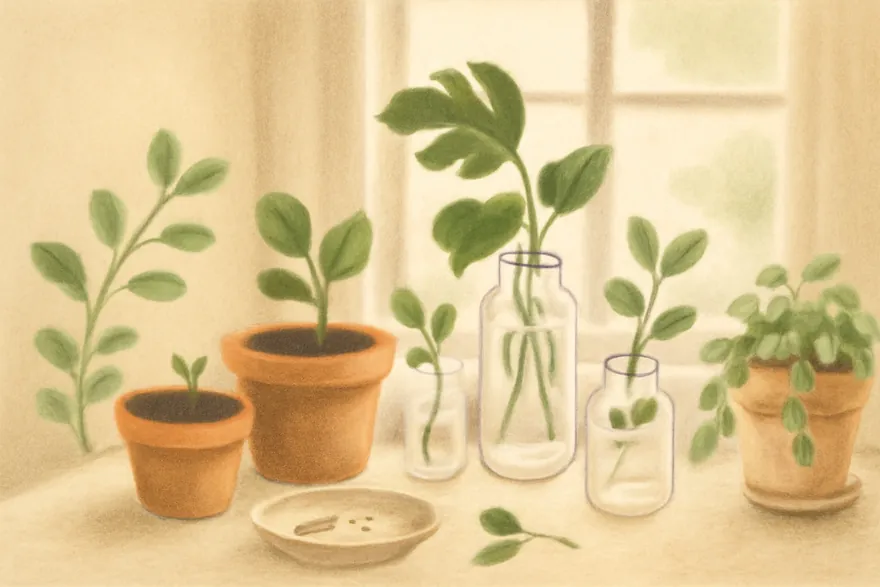
Speed, Cost, and Genetic Certainty: The Three Questions That Actually Matter
Before you pick a method, answer three questions: how fast do you need a usable plant, how much are you willing to spend, and does it matter if the offspring is genetically identical to the parent? Cuttings clone the parent plant exactly, root faster in most cases, and skip the fussy germination window entirely. Seeds are cheaper per plant, are often the only option for true annual vegetables, and let you grow varieties you can't get any other way. Neither method is universally better; the right call depends on the species sitting in front of you.
A seed packet with 25-30 seeds runs about three to four dollars, so each plant costs roughly fifteen cents before you factor in a failed-germination buffer. A cutting from your own plant or a neighbor's is free. A nursery starter plant, by comparison, runs four to twelve dollars. If budget is the deciding factor and the plant roots easily from a cutting, cuttings win outright.
When Seeds Are the Better Bet
Fast, cheap annuals and vegetables
- Basil germinates in five to ten days at 70-80°F and produces a full plant in six to eight weeks. Standard basil seed is cheap and reliable, though sterile hybrids like African Blue basil produce no viable seed and must be started from cuttings instead.
- Tomatoes germinate in five to ten days at 75-85°F. Seed is the practical route for starting a full crop; cuttings from suckers exist but take about as long to mature as new seedlings, so they're only worth it for cloning one proven plant.
- Peppers are slower and pickier, needing 80-85°F and seven to twenty-one days to sprout. A heat mat under the tray noticeably shortens and evens out germination.
Plants that won't root from cuttings at all
Some plants simply have no rooting response in a stem cutting, either because they lack the growth structures needed or because they rarely flower and set seed indoors in the first place, ruling out seed collection too on the houseplant side. Pothos, for example, rarely flowers indoors, so cuttings are the only realistic propagation route rather than a choice at all. On the vegetable side, most true annuals, root vegetables, and grains have no useful vegetative propagation method whatsoever, so seed is not a preference, it's the only door available.
When Cuttings Win
Trailing and foliage houseplants
- Pothos roots in water in two to four weeks with a success rate near 95 percent, making it the classic beginner cutting.
- Tradescantia (wandering jew) roots in five to ten days in water, close to 100 percent success, and is arguably the fastest houseplant cutting there is.
- Coleus roots in seven to ten days in water at over 90 percent success. Seed-grown coleus is a gamble because leaf color and pattern vary from the parent; a cutting guarantees you get the exact look you started with.
- African violets propagate from a single leaf plus petiole, rooting in three to six weeks at roughly 70 percent success. Seed exists but cross-pollinated seed rarely matches the parent's flower color.
Culinary herbs where cuttings preserve flavor
Mint roots from a cutting in about a week with nearly 100 percent success, and this matters more than it sounds: flavored cultivars like chocolate mint or orange mint do not come true from seed, so growing from seed can hand you a plant that tastes like plain spearmint instead of the variety you wanted. Rosemary is the opposite case in terms of difficulty but the same case in terms of preference: seed germination sits around 15-20 percent and takes two to three weeks, then another two years to reach a usable size, while a semi-hardwood cutting roots in three to six weeks at 40-60 percent success with rooting hormone. Most experienced growers skip rosemary seed entirely.
Leaf and rhizome cases with a catch
Many succulents, including echeveria and sedum, propagate from a single leaf: let the leaf callus over for two to four days, then lay it on soil and mist until roots and a tiny rosette appear over two to four weeks, with 70-80 percent success if the leaf pulled away cleanly. Snake plant (sansevieria) leaf cuttings root in four to eight weeks, but there's a catch worth knowing before you cut: variegated cultivars like Laurentii lose their yellow leaf margin and revert to plain green when grown from a leaf cutting. To keep the variegation, you have to divide the rhizome at the base instead.
A Five-Question Checklist Before You Decide
- Does the plant flower and set viable seed indoors at all? If not, cuttings are your only option, not just the faster one.
- Is it a named variety, hybrid, or variegated cultivar? If keeping the exact traits matters, take a cutting or divide the rhizome rather than sowing seed.
- Can you wait six to eight weeks, or do you need a usable plant in two to three weeks? Fast-rooting cuttings like tradescantia and mint beat almost any seed timeline.
- Do you already have access to a parent plant, whether yours or a friend's? A free cutting beats a three-dollar seed packet every time the species cooperates.
- Is this a true annual vegetable or grain? Skip the debate and go straight to seed, since vegetative propagation isn't a realistic path for most of them.
When in doubt, the deciding factor is usually genetics: seeds give you a fresh, sometimes variable individual; cuttings give you an exact copy of a plant you already know and like. Pick based on which of those two outcomes you actually want sitting on your windowsill in a month.
Quick comparison table for: Seeds vs Cuttings: Which Propagation Method to Choose for Your Plant
| Section | What to check | How to use it |
|---|---|---|
| Speed, Cost, and Genetic Certainty: The Three Questions That Actually Matter | Match the conditions and warning signs in this section | Use as a quick practical checklist |
| When Seeds Are the Better Bet | Match the conditions and warning signs in this section | Use as a quick practical checklist |
| Fast, cheap annuals and vegetables | Match the conditions and warning signs in this section | Use as a quick practical checklist |
| Plants that won't root from cuttings at all | Match the conditions and warning signs in this section | Use as a quick practical checklist |
Questions and answers
When should I start a plant from seed instead of a cutting?
Start from seed when you want cheap, scalable planting and especially for true annual vegetables or crops on the house side where vegetative methods are usually not available. The source notes that many true annuals, root vegetables, and grains have no useful vegetative route, so seed is the practical or only choice in those cases.
When should I propagate with cuttings rather than seeds?
Use cuttings when maintaining exact plant identity matters, such as named, hybrid, or variegated plants, and when the species roots reliably from stems or foliage. The source says cuttings clone the parent, often root faster in many common houseplants, and can be free versus buying starter plants, with examples like pothos, tradescantia, coleus, mint, and variegated cultivars needing division to hold traits.