Propagating Plants from Aerial Roots: The Moss Pole Method
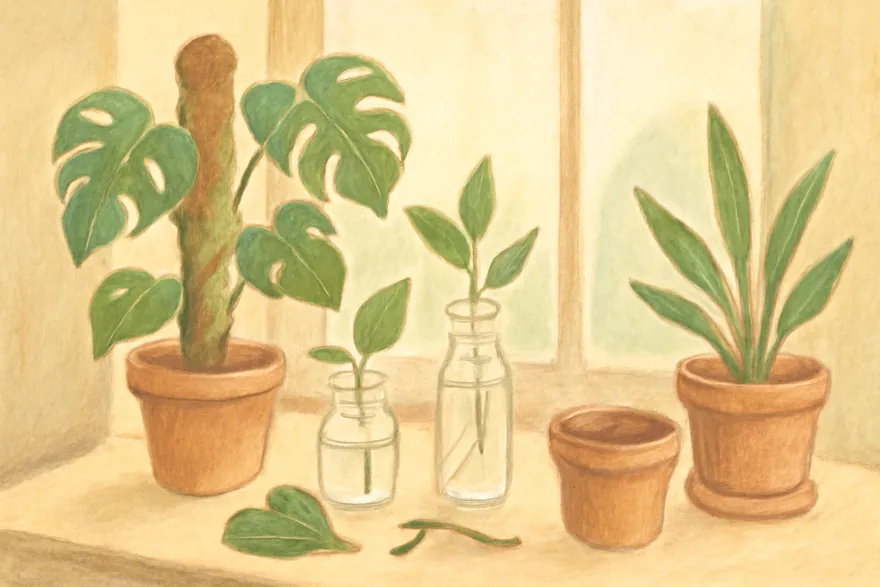
Why Aerial Roots Are a Propagation Shortcut
Aerial roots are the thick, often reddish-brown roots that climbing aroids push out from their stem nodes in open air, reaching for something to grip. On Monstera deliciosa, Philodendron hederaceum, Epipremnum aureum (pothos), Syngonium, and Rhaphidophora tetrasperma, these roots do two jobs: they anchor the vine to bark or moss, and once buried in moist organic matter, they start absorbing water and nutrients almost like a second root system.
That second job is what makes them useful for propagation. A cutting taken from a node that already has a live, functioning aerial root gets a head start most bare-node cuttings do not have. Instead of waiting for a wound to callus and new roots to initiate from scratch, you are potting up a plant that has already begun feeding itself. On a windowsill, where light and humidity are rarely ideal, that head start often means the difference between a cutting that sulks for a month and one that pushes a new leaf within two to three weeks.
Not every aerial root is equally useful, though. Some are short, dry, and mostly there for grip; they never thicken or branch. The ones worth building a propagation strategy around are the ones you actively encourage to grow into damp moss, because that dampness is what triggers them to branch and start functioning as true roots instead of staying as woody anchors.
Building a Moss Pole That Actually Grows Roots
Materials
- A rigid core: half-inch to three-quarter-inch PVC pipe, a thick wooden dowel, or a pre-made coir totem pole, cut about 6 inches taller than the current plant.
- Long-fiber New Zealand sphagnum moss (not sheet moss and not decorative reindeer moss) — it holds several times its weight in water and does not compact into a solid mat.
- Garden mesh, chicken wire, or clear fishing line to hold the moss against the core.
- Twist ties or soft plant tape to attach the stem to the pole every 3 to 4 inches as it grows.
Soak the dry sphagnum in water for 10 to 15 minutes, squeeze out the excess so it is damp but not dripping, then pack it around the core in a layer about half an inch thick. Wrap mesh or wire around the outside to hold it in place, and secure the plant's stem against the pole with ties loose enough to allow another season of growth.
Keeping the moss damp enough to matter
A moss pole that dries out between waterings will not produce functional roots; the plant treats it the same as bare air. Mist the pole itself two to three times a week, and check moisture with a simple squeeze test: grab a small handful and squeeze — one or two drops should come out. If nothing comes out, mist again; if water runs freely, ease off for a few days. In heated winter rooms, misting every other day is often necessary because indoor air can sit below 30 percent relative humidity.
Air Layering: Forcing a New Root Where You Want One
Waiting for a plant to send out aerial roots on its own is slow and unpredictable. Air layering forces a specific node to root while it is still attached to the parent, so you know exactly what you are cutting and when it is ready.
- Pick a node on a mature stem, ideally one that already has a small aerial root nub. Nodes one or two leaves back from the growing tip root fastest.
- With a clean, sharp blade, scrape away a thin strip of the outer stem skin just below the node, about half an inch long, to expose the lighter tissue underneath. This small wound is what triggers root formation; you are not trying to cut through the stem.
- Optionally dust the scraped area with rooting hormone powder containing IBA. It speeds things up but is not required for reliable aroids like Monstera and Philodendron.
- Pack a fist-sized ball of damp sphagnum moss around the node, covering the wound completely.
- Wrap the moss ball in plastic wrap or a small sandwich bag, and tie it off snugly above and below with twist ties so moisture cannot escape.
- Check weekly by peeking under one end of the wrap. Re-mist the moss if it feels dry, then reseal.
Warm temperatures and active growth speed everything up: expect visible roots in 3 to 5 weeks during spring and summer at 70-80°F, and 6 to 8 weeks or longer in a cool, low-light winter window.
Harvesting Rooted Cuttings and Potting Up
Resist the urge to cut as soon as you see the first white root tip through the plastic. Wait until the roots are at least 2 inches long and show some secondary branching — that branching is the sign the root system can actually take up water on its own once it is separated from the mother plant. A single unbranched root that thin usually means the cutting will stall after potting.
- Cut the stem cleanly with sharp, sterilized shears just below the moss ball, leaving the root mass intact.
- Unwrap the plastic but leave the moss packed around the roots — do not rinse it off, since disturbing the fine root hairs at this stage sets recovery back.
- Pot into a well-draining aroid mix, such as equal parts bark, perlite, and coco coir, in a container barely larger than the root ball.
- Cover with a clear bag or place inside a humidity dome for the first 10 to 14 days, keeping humidity above 70 percent while new roots adjust to soil.
- Give bright, indirect light only for the first two weeks; direct sun stresses a root system that has never had to manage transpiration on its own.
If you would rather harvest a root the plant grew on its own along the moss pole, the same rule applies: only cut nodes where the aerial root is at least a couple of inches long and firm, not the short dry nubs near the pole's base.
Common Mistakes and Species Notes
- Cutting too early: a root under an inch long with no branching often means the cutting sits without growing for weeks, or rots before it establishes.
- Overwatered moss: if the sphagnum smells sour or shows black slime, replace it immediately — that is mold, not a sign of good moisture.
- Ties left too tight: stems thicken as they grow; loosen twist ties every few weeks so they do not girdle the stem.
- Pothos and Scindapsus tend to produce shorter, stubbier aerial roots than Monstera or Philodendron and are slower to branch under moss — give air layers on these species extra time, often 6 to 8 weeks, before checking for cut-readiness.
- Philodendron hederaceum and Syngonium root fastest of the common windowsill climbers and are the most forgiving species to practice air layering on first.
Quick comparison table for: Propagating Plants from Aerial Roots: The Moss Pole Method
| Section | What to check | How to use it |
|---|---|---|
| Why Aerial Roots Are a Propagation Shortcut | Match the conditions and warning signs in this section | Use as a quick practical checklist |
| Building a Moss Pole That Actually Grows Roots | Match the conditions and warning signs in this section | Use as a quick practical checklist |
| Materials | Match the conditions and warning signs in this section | Use as a quick practical checklist |
| Keeping the moss damp enough to matter | Match the conditions and warning signs in this section | Use as a quick practical checklist |
Questions and answers
Why does using aerial roots on a moss pole help propagation?
In this method, roots from nodes on aroids like Monstera, Philodendron hederaceum, and pothos first anchor in the pole area and then, once buried in damp organic matter, begin absorbing water and nutrients. A cutting from a node with a live aerial root starts with an already functioning root area, so it avoids waiting for a wound to form and initiate roots from scratch.
How should I prepare and maintain a moss pole for root development?
Use a rigid core with long-fiber New Zealand sphagnum around it and hold the moss in place with mesh or wire, then keep that moss consistently moist. The pole should be packed with damp (not dripping) moss and checked often with a squeeze test; if it drips, the moss is too wet, and if no drops come out, mist again. In this setup, the goal is to keep conditions close to ideal root humidity for the aerial roots to thicken and branch.
When is it safe to cut and pot a rooted node from a moss pole or air layer?
Do not cut as soon as the first white tip appears. The safer standard is to wait until roots are longer and show secondary branching, then cut cleanly just below the moss with the root mass intact. After separation, pot in a well-draining aroid mix and keep high humidity with a bag or dome during early adjustment, while keeping bright indirect light only for the first two weeks.